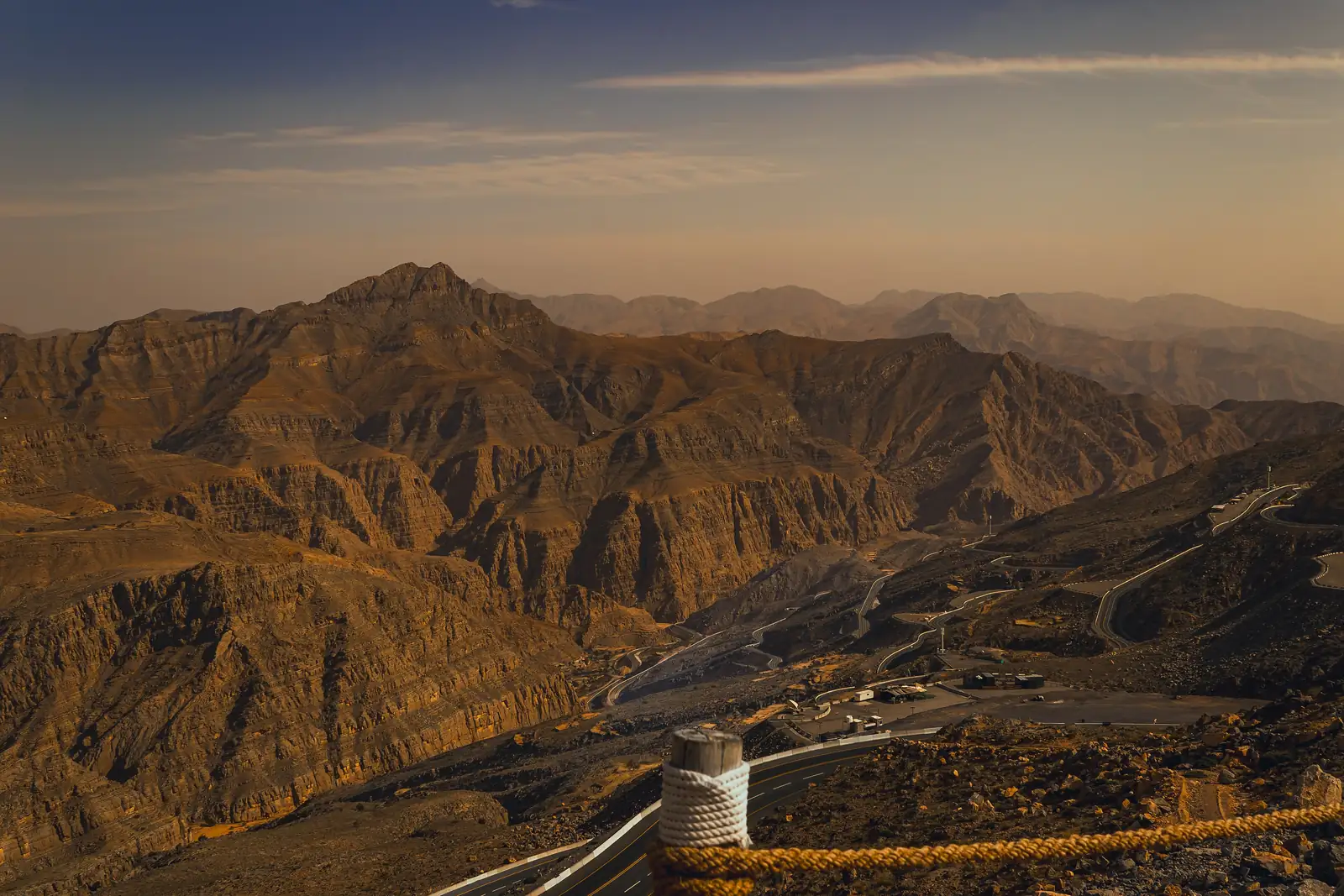
Jebel Jais is the high massif of the northern Hajar Mountains in Ras Al Khaimah, and it is usually called the UAE's highest mountain. Tourism sites give its height as 1,934 metres, but that summit sits just across the border in Oman's Musandam; the highest point on the UAE side is about 1,892 metres, and the highest peak lying wholly inside the UAE is nearby Jabal Ar Rahrah, at around 1,691 metres. In short, Jebel Jais is the UAE's highest mountain mass, with its summit on the border.
You can drive most of the way up. A paved, signposted road of roughly 30km climbs from the edge of Ras Al Khaimah city, with many hairpin bends. It suits an ordinary car, and there is no fuel on the way. Most visitors pull in at Jais Viewing Deck Park, 1,250 metres above sea level, with seven viewing decks, binoculars and two cafés, looking across the Hajar range and, on clear days, towards the Gulf.
The mountain has become an adventure destination. Jais Flight, which opened in 2018 and is billed as the world's longest zipline, runs 2.83km at up to 150km/h and takes around three minutes. Beside it sit the Jais Sky Tour zipline circuit, a sledder, a via ferrata, 1484 by Puro restaurant, Camp 1770 and the Bear Grylls Explorers Camp, plus marked hiking trails. Almost all of these are separate, bookable experiences; the drive itself is free, and Viewing Deck Park charges AED 10.
The climate is why people come. Visit Ras Al Khaimah says the mountain is usually about 10°C cooler than other parts of the emirate, and Wikipedia's 2003–2021 climate record shows a mean annual temperature of 19.0°C, a record June high of 36.5°C and a record February low of -5.7°C. Snow is rare, but it has been documented. The practical catch is that operations are seasonal and weather-dependent: storms closed the mountain in December 2025, and the season is October to April. Check current status before you set out.