
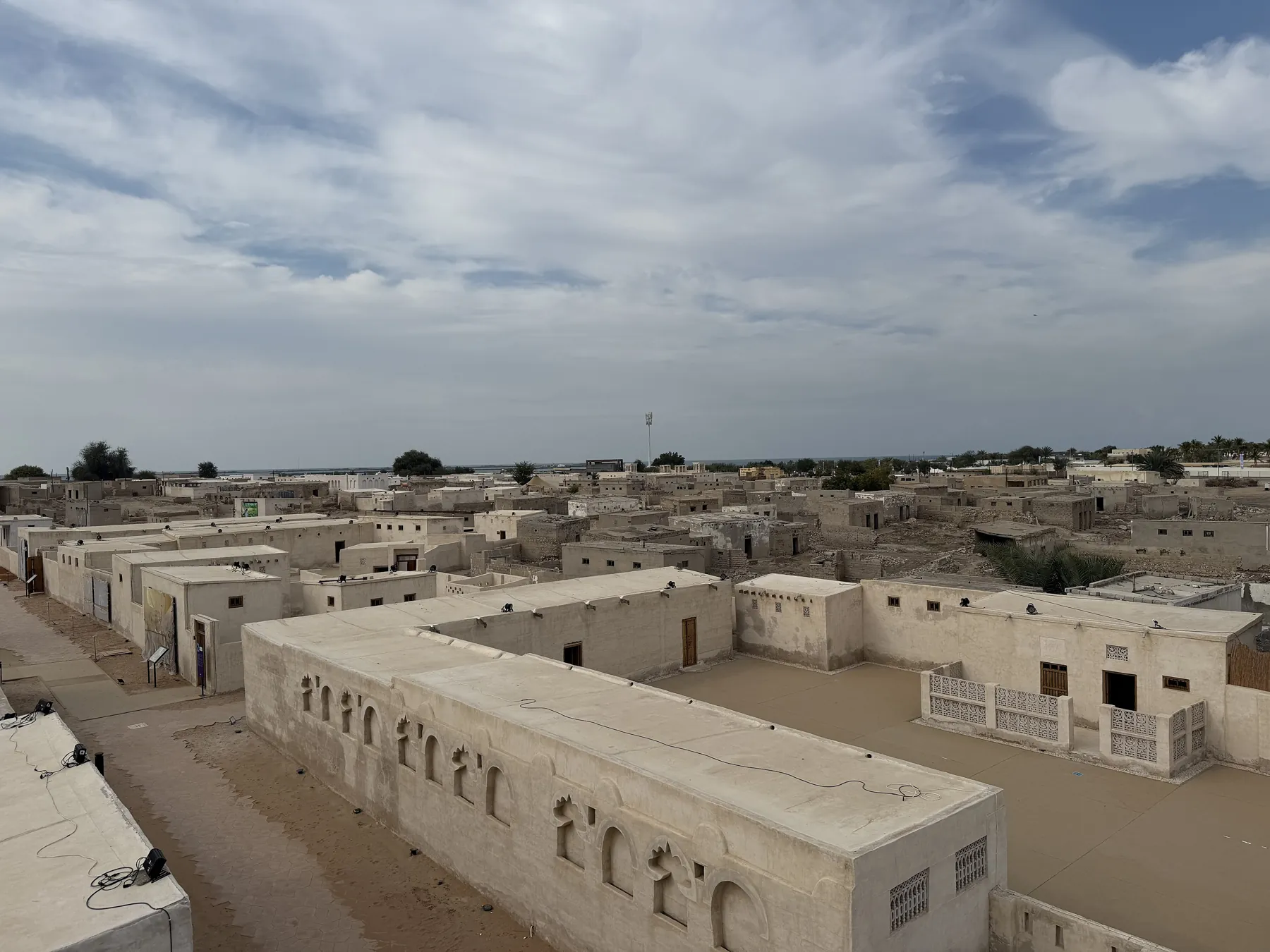
Al Jazirah Al Hamra (Arabic: الجزيرة الحمراء, the Red Island) is an abandoned coral-stone pearling and fishing town on the coast of Ras Al Khaimah. The village's own website says the Za'ab tribe founded it in the late 16th century on a tidal island, and that it stayed an island until the lagoon around it was infilled in the late 1970s. The name is also written Al Jazeera Al Hamra and Jazirat Al Hamra. The National noted in 2014 that it is no longer an island: land has been filled in on all sides, and it now sits near an industrial zone, a port, a water park, a gated community and a golf course.
Pearling is the reason it matters. The village website quotes a Dutch East India Company director who wrote in 1756 that the people of the Red Island lived from pearl-diving and had many small vessels. In 1820 the Za'ab kept a fleet of 25 pearling boats, according to the Ras Al Khaimah Department of Antiquities and Museums. By the early 20th century the village website counts about 500 houses and between 2,500 and 3,000 residents, with fishing, boat-building, ceramics, date farming and a souq that ran a caravan of 100 camels and 100 donkeys to the interior. The pearl trade collapsed from the 1920s, which the village website attributes to artificial pearls and the Great Depression. Residents left between about 1968 and 1971, and the Department of Antiquities and Museums and the village website both say it was abandoned after oil was found. UNESCO has held the town on the UAE's tentative World Heritage list since 26 July 2020, under the title The pearl trading town of Jazirat Al-Hamra. That is a preliminary step, not an inscription.
What you can see today is a mix of restored and ruined buildings. The village website lists a fort with a round watchtower, the souq, the Abdul Kareem House of a prominent trader, the Bin Dulum House of a pearling captain, the large Friday Mosque and six restored courtyard houses. Visit Ras Al Khaimah adds that many other buildings are in ruin or disrepair and that the open-air site is unmanned. The village website says the village has been stewarded since 2010 by the UAE Ministry of Energy and Infrastructure and the Department of Antiquities and Museums, and that the site is now run by the Al Qasimi Foundation with the Department. It lists guided heritage tours of 1 to 2 hours led by trained volunteer guides. The Ras Al Khaimah Art festival is held in the village each winter; the 2027 edition is scheduled for 22 January to 14 February.
Visit Ras Al Khaimah says entry is free and photography is allowed and encouraged, but asks visitors not to climb on or enter the buildings, which may be unstable, and says removing anything from the protected site is prohibited. Opening times differ between the village's own pages, so ring ahead. Many families still own the houses and visit them, according to The National (2014) and Khaleej Times (2016), so treat the lanes as a heritage site and a family place, not a film set. The town also has a reputation as a ghost town: The National (2022) says local legends of hauntings gave it the name Ghost Village. This guide treats that as folklore only and does not verify any story.
 Al Quaa Galaxy
 Empty Quarter
 Hajar Mountains