
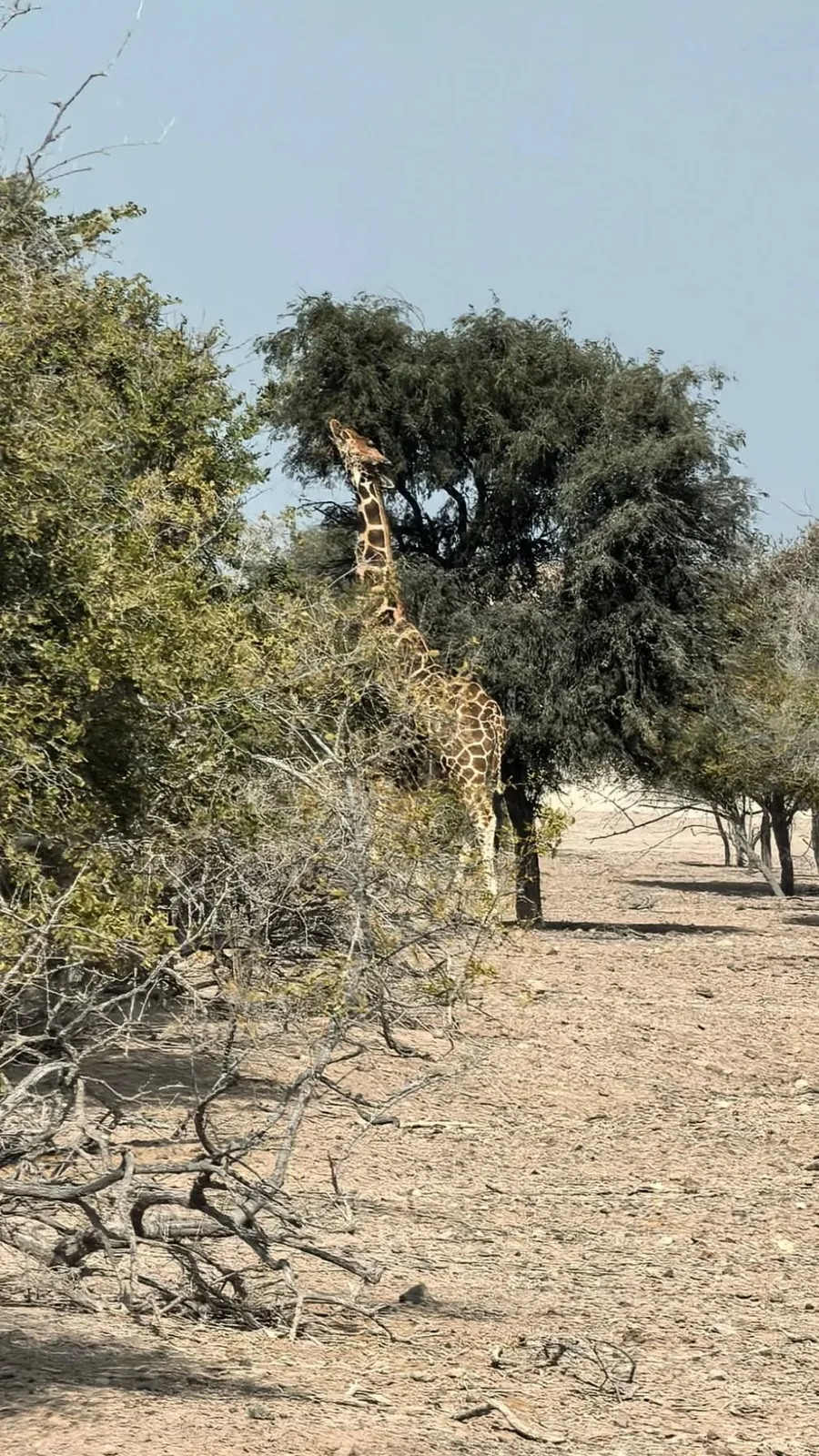
Sir Bani Yas is a natural island off Abu Dhabi's far western coast, in the Al Dhafra region near the mainland town of Jebel Dhanna. It was the private retreat of the late Sheikh Zayed bin Sultan Al Nahyan, the UAE's founding president, who in 1971 set part of it aside as a nature reserve and, through decades of tree planting and captive breeding, turned a dry island into a working conservation project, according to Abu Dhabi's own cultural heritage authority.
That reserve is now the Arabian Wildlife Park, covering roughly 1,400 hectares of the island's 87 square kilometres. Thousands of animals roam it freely, including a large herd of Arabian oryx built up from a handful of founder animals, alongside giraffes, cheetahs, gazelles, Somali ostriches and striped hyenas — species you'd otherwise need to travel to sub-Saharan Africa to see loose in a landscape. Dolphins and sea turtles are recorded in the surrounding waters, and well over a hundred bird species have been logged on the island.
The wildlife park isn't the whole story. Archaeologists have found flint tools around 7,000 years old, a Bronze Age trading settlement roughly 4,000 years old, and the remains of a 7th–8th century Christian monastery — among the oldest confirmed Christian sites in the UAE — evidence that this coast was inhabited and connected to wider trade routes long before oil. Beyond the history, the island has mangroves, salt-dome hills, sandy beaches, and three resorts run by Anantara offering stays, water sports and horse riding alongside the wildlife drives.
None of it is a casual drop-in. There's no bridge, and almost everything beyond the free ferry crossing — the safaris especially — has to be arranged through a resort or a licensed operator before you arrive.
 Al Quaa Galaxy
 Empty Quarter
 Hajar Mountains