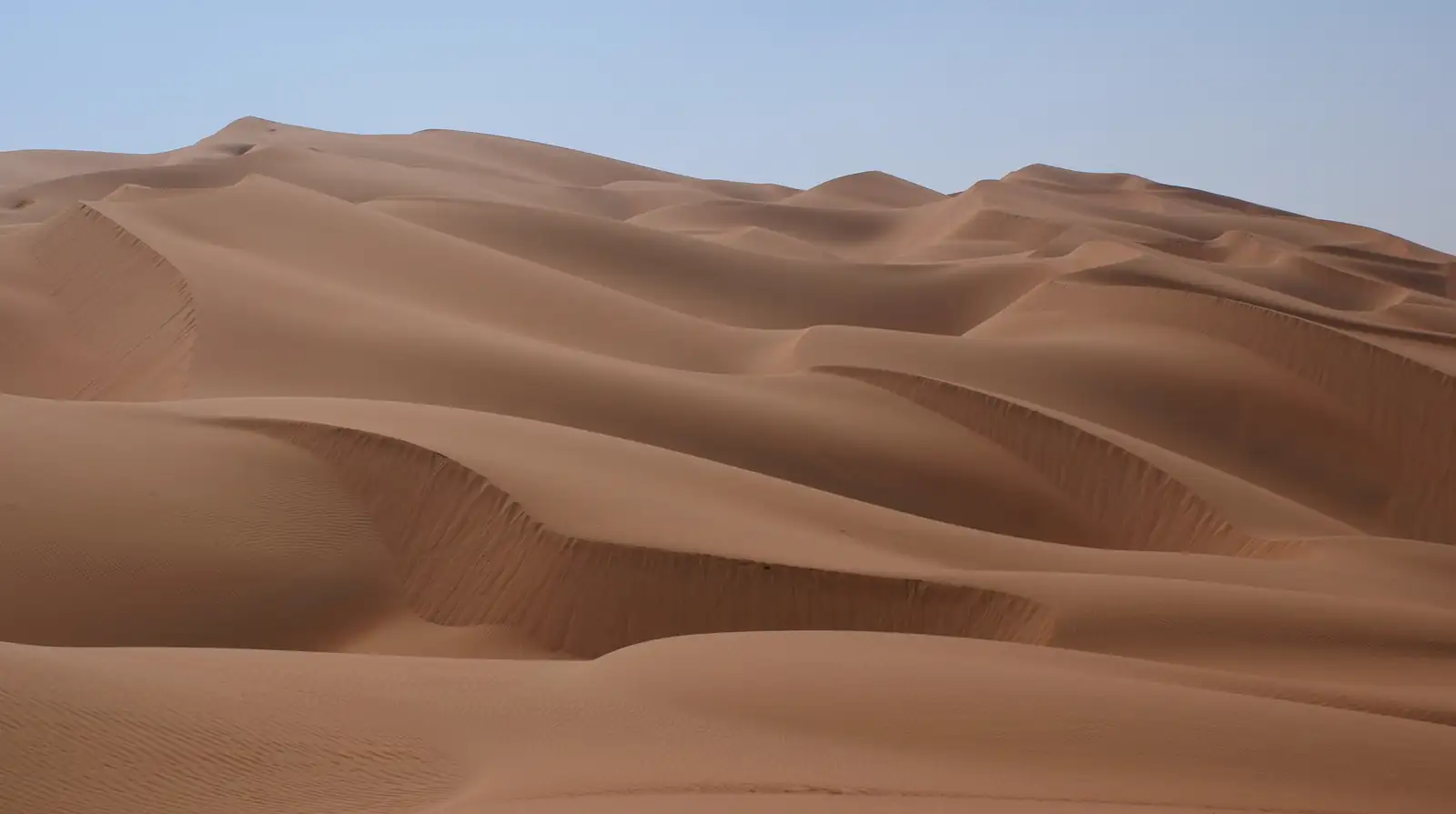
The Rub' al Khali, the Empty Quarter, is a sand desert of the southern Arabian Peninsula. Wikipedia gives it as about 650,000 square kilometres, roughly 1,000 km long and 500 km wide, and Britannica describes it as the largest area of continuous sand in the world. It spans Saudi Arabia, Oman, Yemen and the UAE, and most of it is in Saudi Arabia: Saudipedia puts about 78% there, although its total of 550,000 square kilometres is lower than the Wikipedia and Britannica figure. The UAE holds only the northern edge, around Liwa in the south of Abu Dhabi's Al Dhafra region; most of the sand lies in Saudi Arabia.
The desert is not one uniform sea of dunes. Wikipedia describes dunes up to 250 metres high, reddish-orange from feldspar, with sand seas interspersed with gravel and gypsum plains; Britannica says dunes sometimes exceed 200 metres. Britannica adds that the desert's elevation falls from as much as 610 metres in the west, where the sand is fine and soft, to about 180 metres in the east, where dunes sit alongside salt flats and sand sheets.
Most UAE visitors meet the Empty Quarter at Liwa Oasis. Wikipedia describes an arc about 100 km long on the northern edge of the Rub' al Khali, with some 50 villages, about 97.6 km south of the Gulf coast and 150 km south-west of Abu Dhabi city; the official festival site says it is about a three-hour drive from Abu Dhabi. Paved roads serve the oasis. The Liwa guide covers the oasis and Moreeb Dune in detail; this page is about the wider desert. Every December the Liwa International Festival, which Visit Abu Dhabi says lights up the Empty Quarter with three weeks of motorsport, cultural events, concerts and fireworks, brings crowds to the area.
Qasr Al Sarab is one of the resorts in the area. Its operator, Anantara, describes it as set in the Rub' al Khali, in the Liwa desert area, about 2.5 hours from Abu Dhabi city and 3.5 hours from Dubai, and lists camel trekking, fat biking, archery and desert drives among its activities. Independent camping is the other route: one Liwa tour operator says no permit is needed and that wild camping is allowed on public land only, not private property. That is a single operator's view, so check locally before you pitch. The festival site advises camping with a guide or group if you are new to the desert.
The desert's best-known history is Wilfred Thesiger's. He crossed it twice, in 1946 to 1947 and 1947 to 1948, and wrote about the journeys and the Bedu he travelled with in Arabian Sands (1959). Liwa features in both: the first crossing ended there, and the second passed through it on the way to Abu Dhabi.
Britannica calls it one of the driest regions in the world. Wikipedia gives annual precipitation as generally under 50 mm, and humidity of about 52% in January against about 15% in June and July. Saudipedia says summer highs are above 50°C, and that two or three years may pass without rain. In the UAE, the National Centre of Meteorology recorded 48.6°C at Mezaira, in the Liwa area, on 20 June 2026, as reported by Gulf News. At the other end of the year, one Liwa operator says winter nights can fall to 5 to 10°C.
That range is why timing matters, and why the Empty Quarter rewards preparation rather than spontaneity. The paved roads are easy; the sand is not. Ordinary cars should stay on tarmac, and anyone driving into the dunes needs a suitable 4x4, recovery equipment, more water than seems necessary, a plan for fuel and a way to call for help that does not depend on mobile signal.